
Domestic Electrical Installer (DEI)
Overview
The Domestic Electrical Installer (DEI) qualification (also known as the Part P Installer Certificate) is designed to give professionals the knowledge and hands-on skills required to safely carry out non-notifiable domestic electrical installation work in compliance with UK Building Regulations and BS 7671 standards.
Important note: This qualification is not intended to turn you into a full electrician. Instead, it is suited for individuals whose primary trade is something else (e.g. heating engineers, kitchen fitters, builders) who wish to competently perform certain domestic electrical tasks.
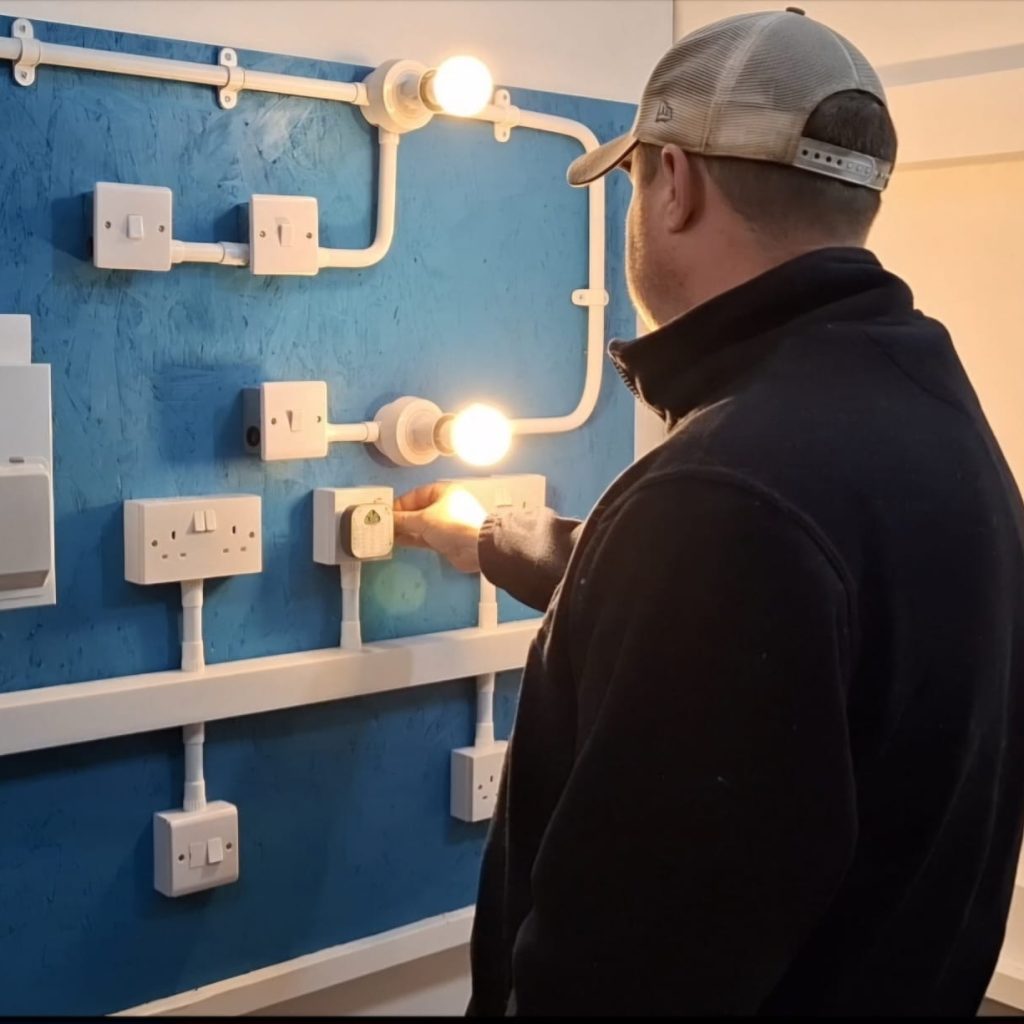
What You’ll Learn
During the DEI course, you will cover both theoretical and practical modules. Key topics include:
Module / Topic | Description |
Electrical safety, legislation & standards | Covering relevant UK regulations, wiring standards, definitions and responsibilities. |
Building Regulations & Part P | Understanding how electrical installation fits into Building Regulations, especially domestic compliance. |
Electrical theory & calculations | Ohm’s Law, power law, voltage drop, cable sizing, load calculations. |
Earthing, bonding & protective devices | Proper earthing systems, protective bonding, types of RCDs, etc. |
Safe isolation procedures | Ensuring circuits are de-energised and safe for work. |
Domestic circuit planning & installation | Wiring lighting circuits, socket circuits (radial, ring), spurs, consumer units, showers, external circuits, etc. |
Special Locations | Bathrooms, outdoors, kitchens: additional precautions and rules. |
Inspection, testing & commissioning | Using test instruments, verifying installation integrity, commissioning, issuing test certificates. |
Fault finding & unsafe installations | Identifying and remedying common faults, recognising dangerous conditions. |
Documentation, certification & notification | Completing test record forms, part P notification where needed, compliance certification. |
Basic understanding of three-phase systems | For awareness and minor applications. |
On successful completion, you’ll achieve the City & Guilds 2393 Building Regulations for Electrical Installations in Dwellings Qualification
Duration & Format
- Guided Learning Hours: A 5-day intensive course, delivered 1 day a week over 5 weeks.
- Delivery Mode: A mix of classroom/theory sessions + workshop practical’s.
Assessment Methods:
• Practical observed tasks
• An online multiple-choice exam
Entry Requirements
- No formal prerequisites are typically demanded.
- However, basic literacy, numeracy and a level of practical aptitude (willingness to do hands-on wiring) are expected.
This course is especially suitable for tradespeople (plumbers, builders, heating engineers, kitchen installers) wanting to expand into electrical work.
Outcomes & Limitations
After completing the DEI course, you will be competent to perform a wide range of domestic electrical works (lighting circuits, socket circuits, consumer unit replacement, etc.)
However, there are important caveats:
- You cannot self-certify major notifiable work unless you are registered under a Competent Person Scheme (CPS) or are supervised by a qualified supervisor.
- Some tasks (e.g. large scale rewires, industrial or commercial installations, solar PV integration) are outside the scope of DEI.
To be eligible for CPS membership (so you can self-certify domestic work), you’ll usually need additional qualifications and experience.
Total Cost:
- £995 + VAT.
Please contact us for more information.